A single source of truth, plus autonomous agents that run each function — diligence, acquisition, monitoring, and workout. You keep the capital and the mandate; the agents do the operating work.
| Loan | Type | Balance | Status |
|---|---|---|---|
| #4821 | Bridge | $512K | CurrentPre-foreclosure |
| #4818 | DSCR | $338K | Performing |
| #4805 | Non-QM | $720K | Performing |
| #4799 | Bridge | $1.10M | Watch |
Every credit fund stitches together originator feeds, loan files, servicer data, spreadsheets, and email by hand — and sourcing, diligence, acquisition, monitoring, and workout are each a team of people moving documents around rather than a system doing the work.
Manual operations don't scale with volume, and volume is exactly what's coming — banks are retreating from commercial real estate while private credit compounds 15% a year onto operators still running on 1990s-vintage systems.
The context that should compound — every loan, borrower, property, and counterparty the fund touches — lives in inboxes and tabs across the org chart, so it never becomes the substrate the fund actually operates on.
Every system a fund already runs on — sourcing, portfolio, servicing, spreadsheets, email — plus external data like county records, valuation and market feeds, unified into one continuously-updated layer that represents every asset, loan, borrower, property and counterparty it touches.
Start with one function and add the rest as you go. Each agent reads and writes the same data layer as it runs its function — it doesn't assist a person doing the work, it does the work.
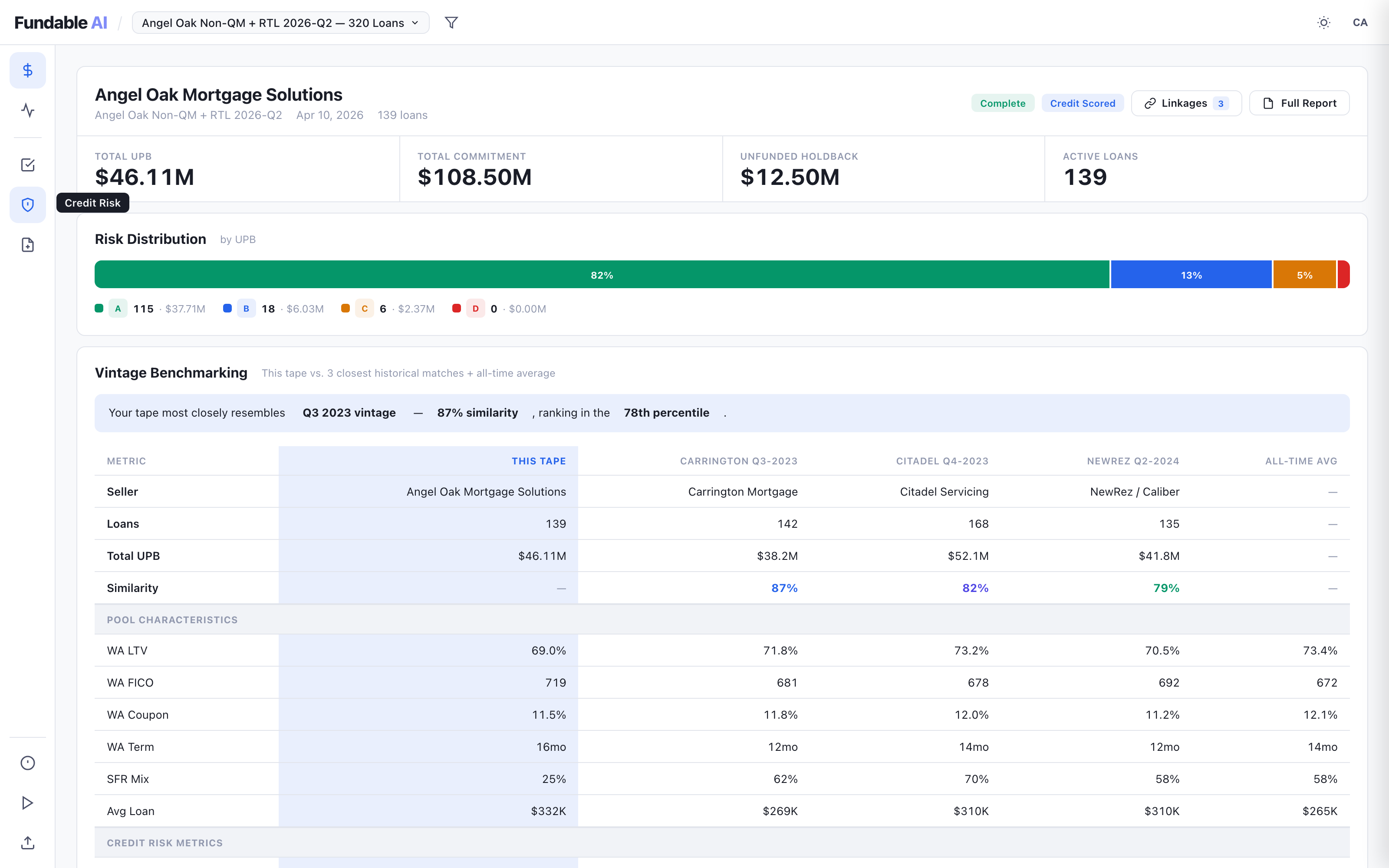
Diligences the originators and sellers behind the paper, scoring counterparty risk before a single loan is bought.
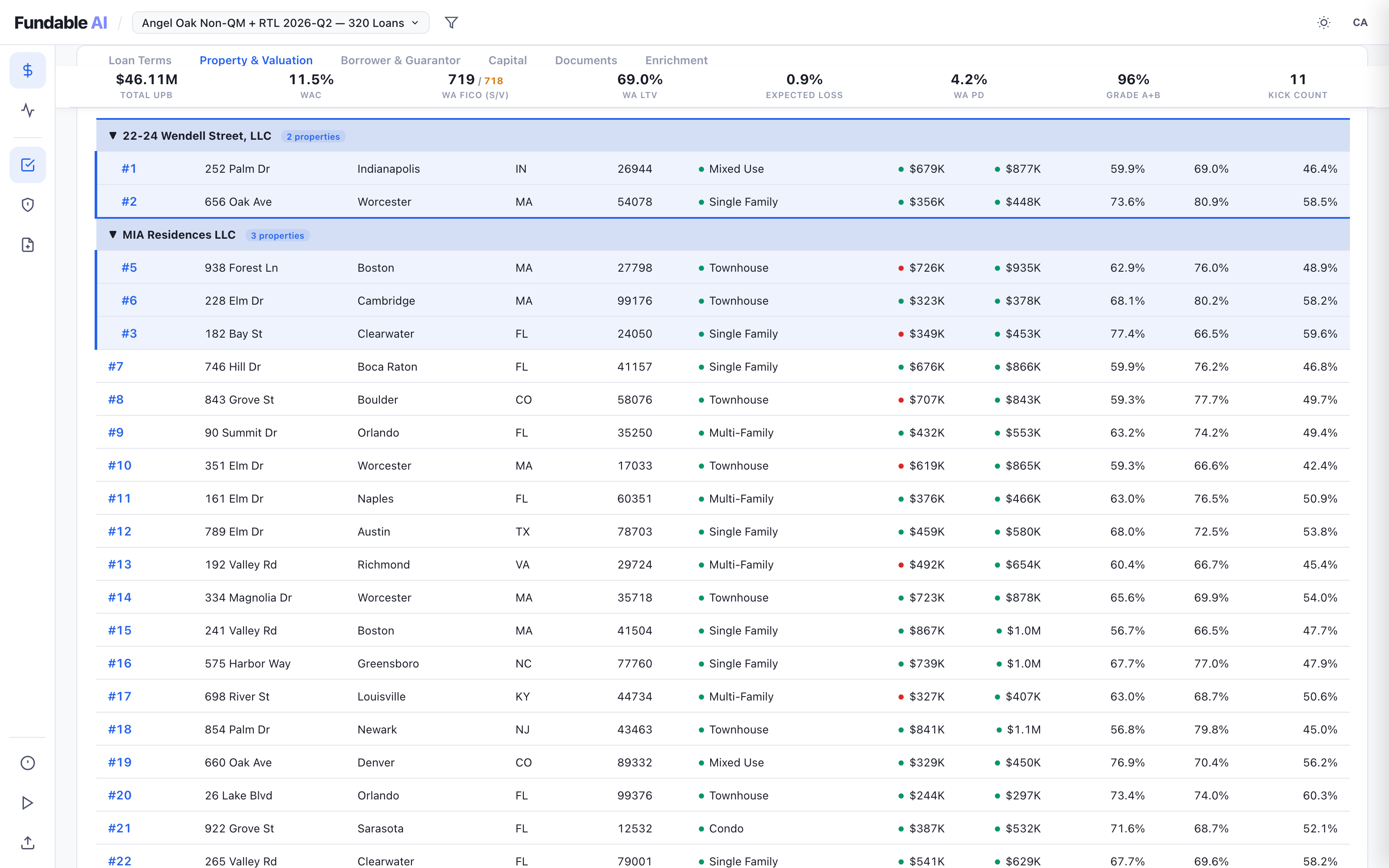
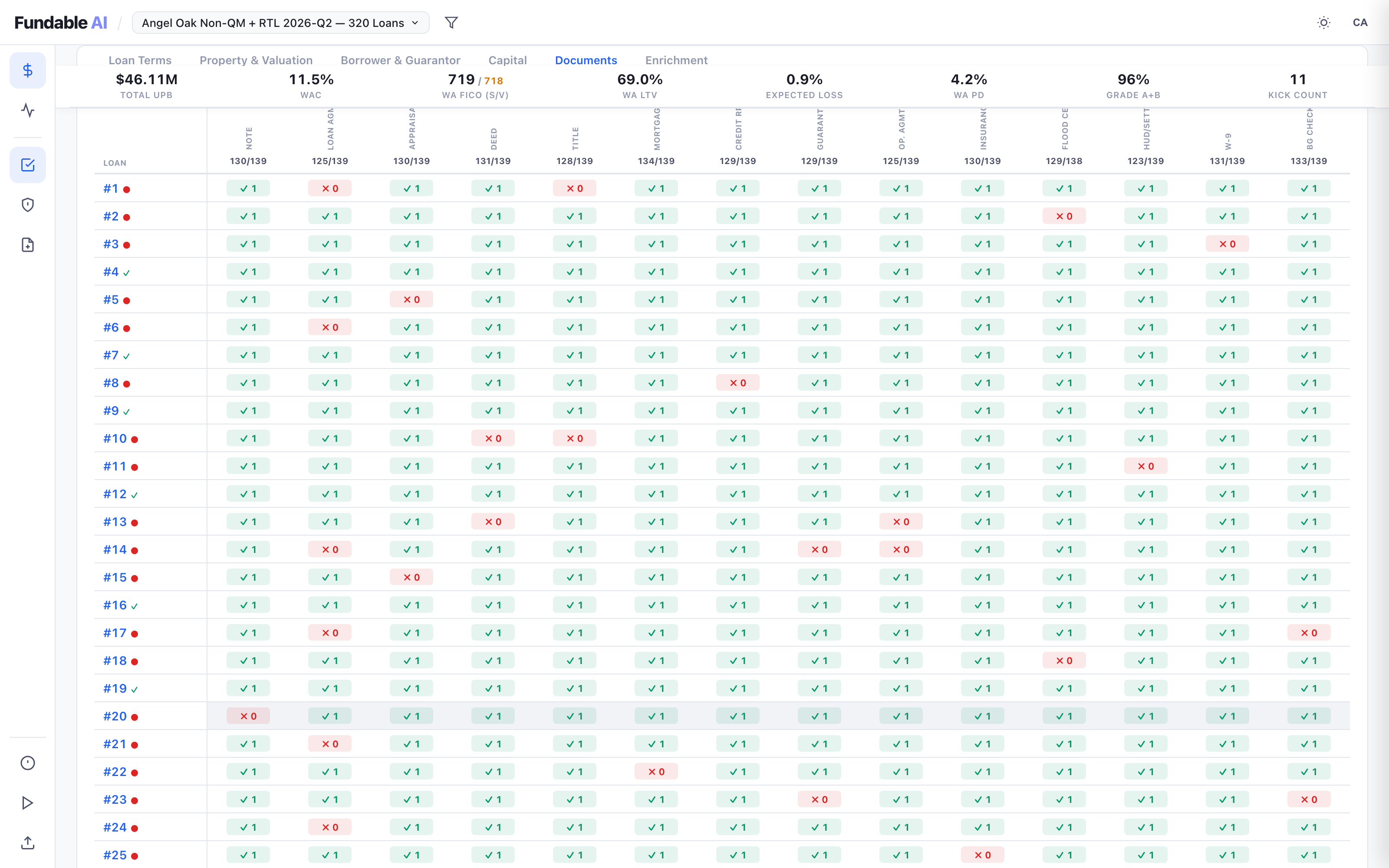
Diligences the loan — including decomposed valuation — and runs the purchase into the book, taking tape-to-bid from weeks down to hours.
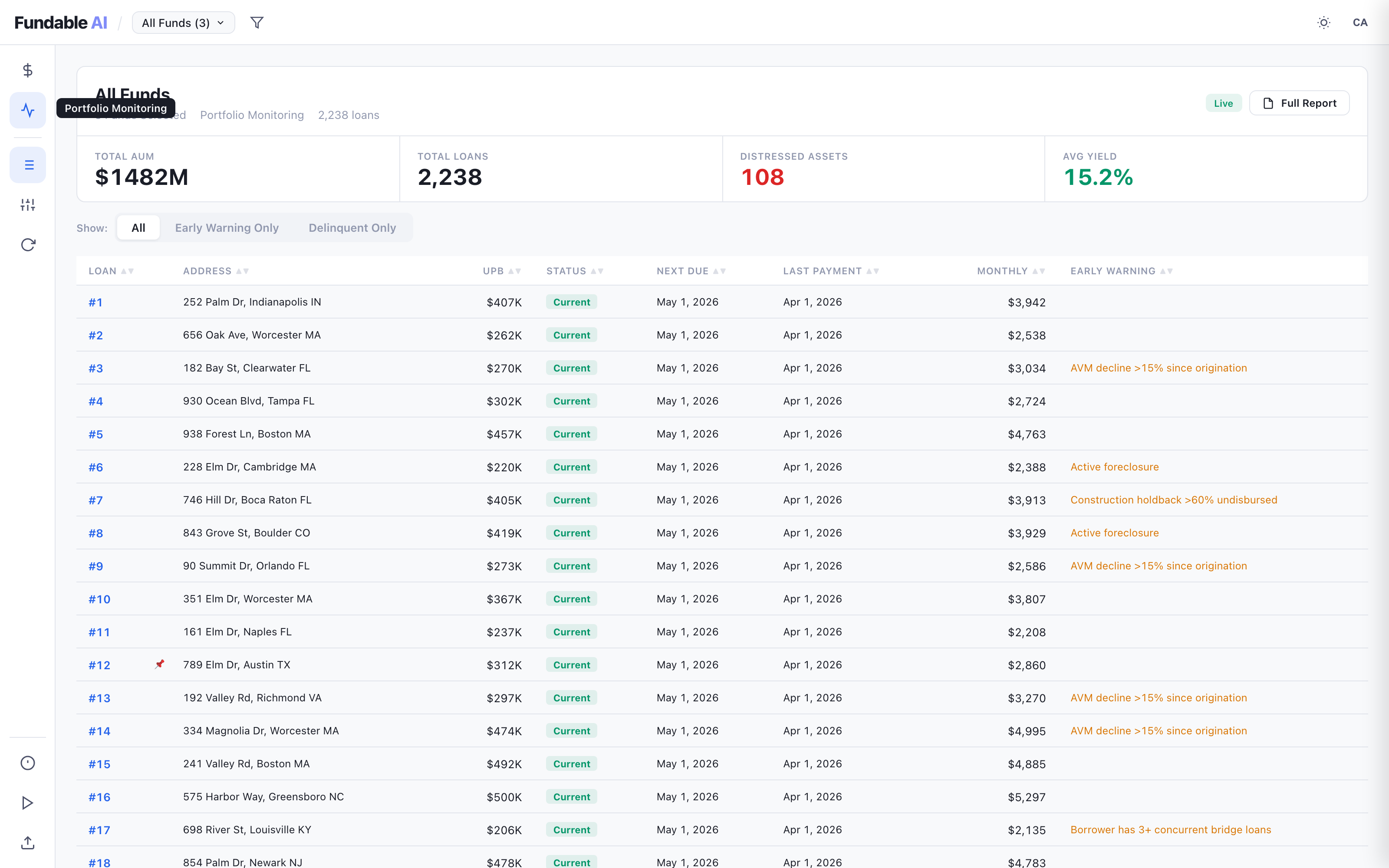
Watches the book across performance, covenants, and early-warning signals, flagging the loan that's about to turn before it does.
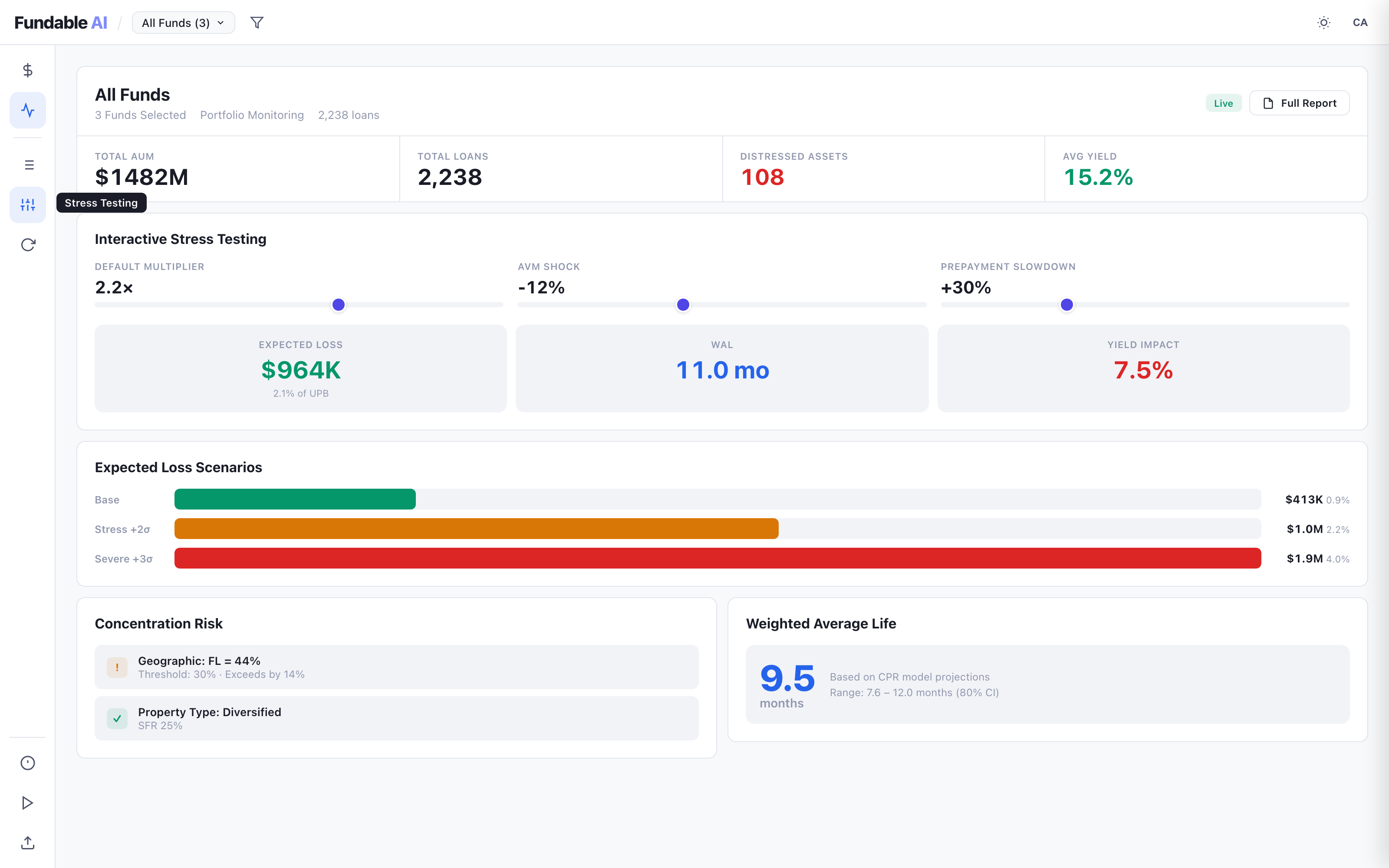
Produces LP, fund and position reporting on demand, and coordinates the external services a fund buys — all from the same source of truth.
Recovers distressed loans matched to the investor's mandate — the highest-stakes function, where a non-performing loan costs 10–13× the labor of a performing one.
You pay per agent, and because the data layer is built once, each new agent runs on a foundation that's already there rather than starting from scratch.

If your fund buys, holds, monitors, or works out asset-based credit — CRE bridge, fix-and-flip, DSCR, and Non-QM — this is the layer underneath it: one platform beneath every function your team runs.
Funds buying and managing asset-based credit who need to scale operations with volume, not headcount.
Teams buying hundreds to thousands of loans a month who need tape-to-bid in hours, not weeks — diligence and acquisition calibrated on loan outcomes well beyond your own book.
Bridge, hard-money, and DSCR lenders who need documents handled and investor-grade output for faster secondary-market sales — clean data that feeds the platform.
Pagaya is an asset manager, and Hod built the infrastructure that ran it — origination through securitization, $10B+ a year — with Chen running the ML and data engineering there and at a credit hedge fund before it.
That infrastructure was built for people to do the work. We're building the same infrastructure with AI doing the work — and offering it as a platform to every fund, instead of running one ourselves. Read the full story →
Led ML and data engineering at a credit hedge fund and at one of the largest AI-driven credit platforms. Deep expertise in document AI, decisioning, and the data layer underneath it.
Built the origination, underwriting, and risk infrastructure that ran an asset manager processing $10B+ a year — origination through securitization.
Fundable is the AI platform for fund and asset managers. It unifies the systems and data a fund already runs on into a single source of truth, then deploys autonomous agents on top that do the operating work of each fund function — diligence, acquisition, monitoring, and workout. The fund keeps its capital and its mandate; Fundable runs the operation as software instead of headcount.
Fundable is built for credit and asset-based finance funds, note buyers and credit investors, and originators in bridge, DSCR, and Non-QM lending. It fits any manager that buys, underwrites, monitors, or works out asset-backed loans at volume and needs to scale on systems rather than people.
First it connects to the systems and feeds a fund already uses — loan tapes, originator feeds, servicer data, spreadsheets, email, and public records — and turns them into one continuously updated source of truth. Then it deploys vertical AI agents on that foundation, each running a specific function across the asset lifecycle. Funds typically start with the one function that hurts most and add the others on the same data foundation over time.
Fundable starts with asset-based and real-estate credit — CRE bridge, fix-and-flip, DSCR, Non-QM, and residential mortgage notes. The same single-source-of-truth foundation extends across asset-based credit as a fund activates more functions.
Adding headcount or a third-party review (TPR) firm scales linearly — more volume needs proportionally more people, and each reviewer still sees only a slice of the loan. Fundable turns the work into software on a unified data foundation, so once a fund's data is in one place each agent compounds on it and capacity scales without proportional headcount.
Your data stays yours. Fundable deploys into the environment you choose — managed cloud, a dedicated single-tenant environment, your own VPC, or fully on-prem — with encryption in transit and at rest, least-privilege role-based access, per-decision audit trails, and retention policies you control.
Fundable is a platform subscription that expands as a fund activates more agents. Funds start with one function and add others on the same data foundation, so cost tracks the value delivered rather than seat count. Talk to us for specifics.
Tell us which function hurts most — sourcing, diligence, acquisition, monitoring, or workout. We'll show you the agent that runs it and how we'd deploy on your data.
Talk to us